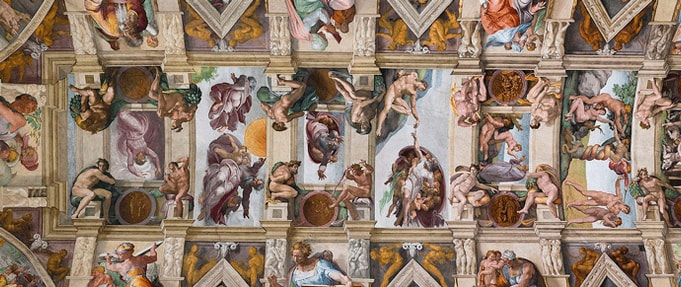
With its stunning Renaissance frescoes—especially Michelangelo's ceiling depicting scenes from Genesis—the Sistine Chapel is among the most well-known structures in the world. A UNESCO World Heritage Site, the chapel receives over six million visitors each year, meaning roughly 25,000 people set foot into the hallowed building every day.
The main attraction of Vatican City, the Sistine Chapel, has been around for over 540 years. Thus, since its opening in 1492, 26 conclaves—the process by which a new pope is chosen—including the recent election of Pope Leo XIV in May 2025, have been held under Michelangelo's frescoes.
More than being the site of the Papal conclave, the Sistine Chapel is, without a doubt, the most important sacred space of the Roman Catholic Apostolic Church. But how did the building attain this status, and why does it continue to draw crowds to this day? Read on to unlock an illuminating history of the chapel.
The Construction of the Sistine Chapel
Originally called the Cappella Magna, meaning ‘Great Chapel,’ the Sistine Chapel was named after its commissioner, Pope Sixtus IV. Originally located on the site of the Cappella Maggiore, ‘Greater Chapel,’ by the time of its demolition to make room for the present chapel, the building was reported to be in poor condition.
Designed by Baccio Pontelli and constructed under the supervision of Giovannino de Dolcis between 1473 and 1481, the simple brick building with six arched windows and a barrel-vaulted ceiling has a deceptive exterior. For it is the interior walls and ceilings, executed by the master painters of the Florentine Renaissance, that are the real draw.
During Pope Sixtus IV’s reign, a team of painters, including Sandro Botticelli, Pietro Perugino, Pinturicchio, Domenico Ghirlandaio, and Cosimo Rosselli, designed several frescoes, including the Life of Moses and the Life of Christ, as well as papal portraits.
Completed in 1482, the Sistine Chapel was consecrated and dedicated to the Virgin Mary on 15 August 1483, the Feast of the Assumption, at which the first Mass was held.
Only from 1508 to 1512 was Michelangelo brought in by Pope Julius II to paint the ceiling, an event considered one of human civilization’s pinnacle achievements. The ceiling was shown to the public for the first time on November 1st, 1512. Later, after the Sack of Rome, he returned to paint The Last Judgment on the west wall, for popes Clement VII and Paul III, between 1535 and 1541.
According to History, at first, Michelangelo refused to paint the Sistine Chapel. In 1508, when Pope Julius II asked the artist, he was working on a marble tomb for him. He stated that he was a sculptor, not a painter, had no experience with frescoes, and ultimately wanted to complete the tomb. But over time, he relented and spent four years with a brush in hand, elevated by scaffolding.
The frescoes, which have come to be known as the Sistine Ceiling, show events and people from the Old Testament. The most famous is the Creation of Adam, which depicts God's and Adam's arms extended toward one another. Meanwhile, The Last Judgment, located on the wall above the altar, exhibits Christ’s damnation of sinners and upholding of the virtuous.
In 1989, the ceiling was restored by cleaning and removing centuries' worth of smoke, dirt, and varnish. In 1994, the same process was applied to The Last Judgment.
Electing a New Pope
Today, the Sistine Chapel’s most significant function is electing each successive pope, after the current one dies or resigns, in the conclave of the College of Cardinals.
When the conclave is held, a chimney is built into the roof of the chapel, in which smoke will arise each day as a signal. If black smoke appears, that means the new pope hasn’t been elected by the required two-thirds vote. If white smoke appears, it indicates that the new pope has been successfully chosen.
For however long it takes to reach a two-thirds majority, the cardinals who have gathered from all over the world will be locked in the Sistine Chapel, isolated from the outside world. It’s a highly sacred moment for the church, one that even inspired a recent Oscar-winning film titled Conclave, starring Ralph Fiennes, John Lithgow, and Stanley Tucci.
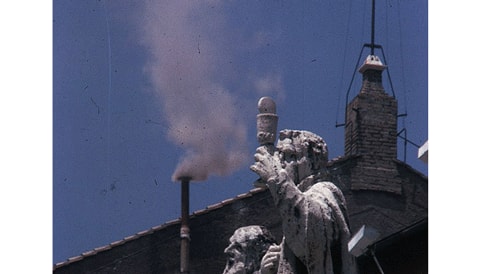

White smoke rising from the Vatican at the election of Pope Paul VI in 1963.
Photo Credit: Wikimedia CommonsThe first conclave held in the Sistine Chapel was in 1492, from August 6 to 11, and resulted in the election of Pope Alexander VI. Since then, 26 conclaves have been held, the most recent in May 2025.
Beyond serving as the site of papal conclaves, the Sistine Chapel also houses the Papal Chapel, one of two components of the papal household (formerly known as the papal court). The Papal Household ultimately assists the pope in carrying out ceremonies, whether religious or civil.
All in all, the Sistine Chapel, Vatican City’s most visited landmark, not only preserves some of the world’s most celebrated art but also serves as the setting for one of Catholicism’s most vital rituals, making it an enduring cornerstone of global culture.
Featured image: Wikimedia Commons


