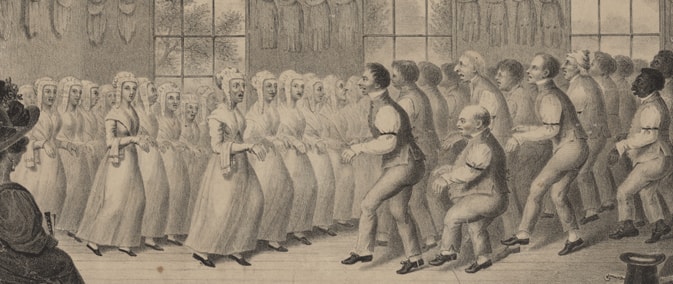
Hearing of these self-contained communities throughout the “New World,” curious visitors would regularly come to watch. In fact, it was outsiders who nicknamed them “Shakers” because they watched them shake, spin, and dance during their services.
Originally a small branch of English Quakers founded by Jane and James Wardley in 1747, the Shaker doctrine, as it came to be known in the United States, was shaped by Ann Lee, a textile worker in Manchester. Rejecting traditional marriage and procreation, and embracing pacifism just as the American Revolution began, the movement was highly controversial.
An unlikely leader born into poverty, Lee managed to gain thousands of followers to her teachings—but how did she do it?
Mother Ann and the Second Coming
In the 2025 historical musical The Testament of Ann Lee, Amanda Seyfried stars as the charismatic leader, from growing up in Manchester to bringing the Shaker movement to America. Mona Fastvold, the director, said in an interview with the BBC about making the film, “I was just truly fascinated that there was this woman with these radical ideas and that it was part of American history.”
“Mother Ann,” as she would come to be known to her followers, had a difficult marriage, with all four of their children having died young. In 1758, she converted to the “Shaking Quakers,” known for ecstatic dancing and singing during worship, and later simply called “The Shakers.” Eventually, her imprisonment for her partaking in the services led her to reflect and receive a series of revelations. She regarded herself, and therefore her followers saw her, as the Second Coming of Christ in female form: “It is Christ who dwells in me.”
Shakers today clarify this belief on their website: “Mother Ann was not Christ, nor did she claim to be. She was simply the first of many Believers wholly imbued by His spirit, wholly consumed by His love.”
Lee continued to develop the theology, making celibacy the community's core principle. With her eight disciplines, she traveled to America in 1774 and established the millennial church in the New World. Ultimately, they settled in Niskayuna (near Watervliet), New York, and within five years, their movement had accumulated over 5,000 members.
But as they gained momentum, criticism followed. In the earliest anti-Shaker pamphlet, written in 1781, apostate Valentine Rathbun spoke out against their seemingly random movement and singing: “It is impossible to point out any exact form, for they vary and differ and seldom act the same form exactly over again. They chuse to do so, to be singular, lest, as they say, they should be connected with Babylon.”
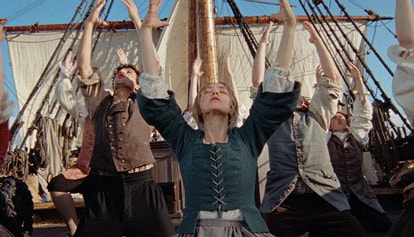
 Photo Credit: Searchlight Pictures
Norm-Breaking Beliefs
As Daily JSTOR describes, those against the Shakers “seemed most concerned with the way Shaker songs did not conform to European harmonies, and with how their dances refused the couple-pairings that formed the nucleus of European-American folk dance.”
Early pioneers of religious egalitarianism often split leadership roles equally between men and women, called elders and eldresses. Members called one another brothers and sisters and were admitted regardless of race or background. According to documents, Black Americans were viewed as equals, and in some cases, even purchased the freedom of enslaved believers in the Shaker community.
Lee’s most crucial and controversial belief was the insistence on celibacy. She viewed sex as the root of all evil. Shakers were additionally prohibited from marrying or even touching someone of the other sex. Communal buildings were similarly divided—women ate together, and men did the same.
They also practiced pacifism, which caused contention during the Revolutionary War, when they refused to participate. Over time, their separation from the outside world relaxed, with visitors eventually welcome to watch or even participate in worship. To grow their community, Mother Ann and her followers would partake in missionary work—but were often mobbed and beaten.
Nevertheless, Lee stayed steadfast in her beliefs until her death in 1784, a decade after her arrival in America—with some believing that injuries she sustained while being beaten contributed to her death.
Animated Worship
The expressive dance practice of the Shakers was known as “laboring.” Characterized by swaying, shuffling, hand movements, and gestures, laboring was separated by generations and often lasted for hours. From the 1700s and mid-1800s, the practice began as largely impulse-based, until it became more of a choreographed worship, then returned to spontaneous movements again.
By the end of the 19th century, the laboring practice ended—though the singing legacy endured. After Mother Ann’s death, a period of spiritual excitement called the Era of Manifestations began, and so did many Shaker songs and hymns. The song “Simple Gifts” is regarded as the most famous of this time, thanks in part to composer Aaron Copland, who arranged it in the 1940s.
Shaker Furniture and Legacy
During the 1840s, the Shaker movement reached its pinnacle, with 6,000 members. But with the church’s insistence on celibacy and rejection of childbirth, membership slowly declined, and by 1905 there were only 1,000 members. As of 2025, only three remain.
The simple craftsmanship of Shaker meeting houses and buildings has had a lasting impact on American culture. In line with their ascetic practice, each piece of furniture they designed was meant to serve its intended purpose—nothing more. To make a thing well, according to Shakers, was in itself an act of prayer and dedication.
Beyond furniture, the Shaker community is remembered as one of the first effective practices of utopian living. Ahead of its time in equality, pacifism, and dedication to communal ownership, there is still much to learn about how Shakers practiced, and ultimately cherished, life.


