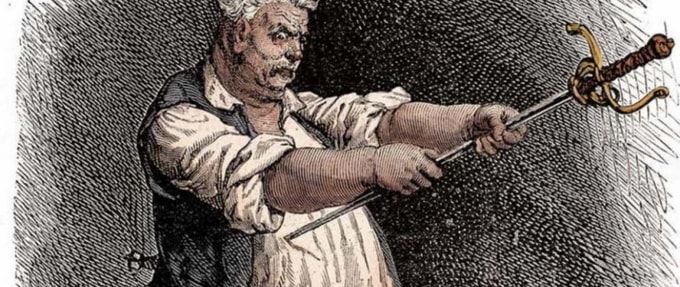

In the new biopic, Tony, about the formative years of celebrity chef and food writer Anthony Bourdain, the 19-year-old Tony (Dominic Sessa) notices a painting hung in the kitchen of the seafood shack where he’s watching dishes. He asks the restaurant’s chef and owner, Ciro (Antonio Banderas), about it.
The painting’s subject is France’s François Vatel. Ciro summarizes the story by saying François Vatel was in charge of preparing a feast for King Louis XIV and his 600 courtiers. When the fish he ordered did not arrive on time, he killed himself.
Tony asks, “What?”
And Ciro repeats with comedic affect, “The fish he ordered did not arrive on time, so he killed himself.”
A closer look at François Vatel’s life reveals a more complex story, naturally.
Most of what we know about Vatel, according to Charles Perry in the LA Times, comes from the Marquise de Sevigne’s gossipy letters to her daughter. She relates what she learned about him by staying nearby, and she writes mostly of the three days before his death.
But of course, François Vatel’s story begins earlier than that. In 1661, Vatel was the banqueter and chef to the marquis and Vicomte Nicolas Fouquet, who was the former Minister of Finance. Fouquet had just finished the chateau at Vaux-le-Vicomte, so he invited the king to visit.
During their stay, the king and his entourage saw gardens that exceeded those at Versailles, a new play by Moliere, a firework display, and then banqueted (organized by Vatel, maître d’hôtel, which translates to “head domestic” or “house master”) on pheasants and roast peacocks on solid gold platters.
The King realized at this visit that the funds used to build this extravagant chateau were supposed to come to him, so according to Daniel M. Lavery in Lapham’s Quarterly, he threw Nicolas Fouquet into prison for embezzlement. François Vatel fled the country for his own safety—but the king had been impressed by the artisans involved. Bryan G. Newman’s article in Behind the French Menu says the architect, painter, and gardener from Vaux-le-Vicomte all took jobs working for the king.
When François Vatel returned to France in 1669, he went to work for the Prince de Condé in the Château de Chantilly. Legend says that this is when he invented Chantilly cream.
In France, and among French chefs, François Vatel is viewed as a sort of martyr to their national art form, la grand cuisine. However, at the moment he’s most famous for, Perry confirms that Vatel was not even truly a chef.
Vatel was Contrôleur Général de la Bouche, which meant he was essentially the butler of an enormous chateau—but that did put him in charge of orders and shipping.
The story goes that in the spring of 1671, Louis de Bourbon welcomed King Louis XIV to a three-day visit (that’s Thursday, 23 April, through Saturday—relevant, I promise) to his chateau in Chantilly. The servants had 15 days’ notice to prepare to wow the Sun King and his entourage for three straight days.
It is said that it did not start off well: not only were the fireworks Vatel organized completely obscured by fog, but the second banquet was to take place on a Friday. That meant no meat could be served.
Behind the French Menu goes into great detail about the procurement of seafood for this Friday-night banquet, but prefaces all deduction by the disclaimer that there are endless disputes about what fish Vatel ordered. It almost certainly would not have been saltwater fish because—although “oysters and mussels could be brought (from Paris) alive in damp straw,” before the use of ice, “large quantities of saltwater fish in good condition would have been impossible.” Plus, saltwater fish would not have impressed the king, since it was part of the daily menu around Paris.
The exact order is not known, but Vatel likely would have ordered pike and trout and other fish and crayfish that “could be kept in holding pools and brought fresh whenever ordered.”
On that Friday morning, the fish that arrived would not have fed even one quarter of the guests. Vatel saw the impending disaster, and according to Perry, with the dignity of an aristocrat, Vatel ran onto his sword in his bedroom. As Laverty says, “It is ridiculous to die for fish, it is impressive to die for honor.”
Everyone was shocked, but Vatel’s body was discreetly removed for burial, and a fellow manager, Jean Hérault de Gourville, “took over the supervision of the king’s dinner that evening.” Daniel M. Laverty goes on to confirm that the banquet was “unanimously considered a success.”
It’s no coincidence that the writer and director of Tony, Matthew Johnson, included François Vatel’s portrait in this story of Anthony Bourdain’s formative years. And it’s no accident that Ciro emphasizes the significance by telling the story twice: he doesn’t want us to miss it. François Vatel is a shorthanded foreshadowing/homage to America’s beloved folk hero chef, Anthony Bourdain, who also died by suicide.
Although Anthony Bourdain said in Kitchen Confidential that he was not pushing for any sort of kitchen reform by writing the book, the job of cook is notoriously grueling, demanding, and belittling. (Look at The Bear for further supporting evidence in dramatic form.) It always has been.
And that’s why François Vatel has achieved this folk hero status, “held up as a patron saint of the exacting, the harried, the hurried, and all those beset by an unexpected dinner rush.”


