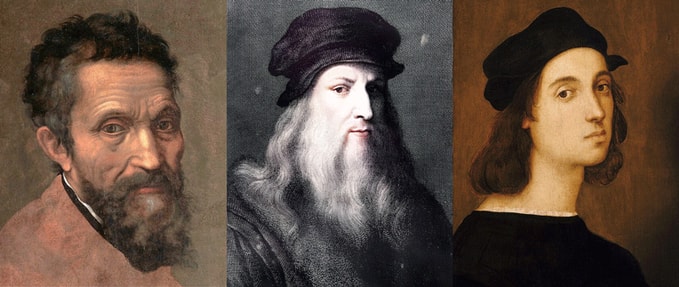
Uniting the Middle Ages and modern-day civilization, the Renaissance was a pivotal period in European history. Each country entered this movement at different times, but Italy is generally regarded as the first in the 14th century, whereas it did not reach England until the 16th century. Among historians, the general consensus is that the Renaissance ended by the 17th century.
But what was the movement? Characterized as a “rebirth,” the Renaissance resurrected Europe from the “Dark Ages”—a time of war, famine, and the Black Death. A shift towards humanism in the 14th century is largely responsible for building the momentum that would result in the Renaissance. Above all, humanism placed man at the center of the universe—and thus put people’s achievements, whether in education, literature, or science, on a pedestal.
Key events during this time include the fall of Constantinople, the Age of Exploration, the Protestant Reformation, and the invention of the printing press. In particular, the latter led to advanced communication among proponents of the humanist movement, such as Francesco Petrarch and Giovanni Boccaccio, which ultimately promoted a return to traditional Greek and Roman culture.
Beginning in Florence, Italy, the Renaissance was supported by wealthy citizens who could afford to sponsor emerging artists. The Medici Family, who held power in Florence for more than 60 years, famously backed the movement. In particular, Cosimo de' Medici and Lorenzo the Magnificent financed the foremost Renaissance masters: Leonardo da Vinci, Michelangelo, and Sandro Botticelli.
The art produced during this period saw a profound shift towards realism, with heightened awareness of nature, a resurgence of classic influences, and a more individualistic approach to subject matter. Simply put, medieval art was primarily symbolic and religious, whereas Renaissance art prioritized the artist. With the rise of merchants such as the Medici family, artists had the freedom to develop new techniques that more directly represented the physical world.
The strides made in the Renaissance ultimately altered the course of art in ways that continue to resonate today. By doing away with anonymity, humanism gave the world its first celebrity artists. These figures quickly came to embody the ideals of the Renaissance man, who studied science and developed art.
The following four painters were among the most groundbreaking figures of the Renaissance, creating works that the world continues to revere today.
Leonardo da Vinci
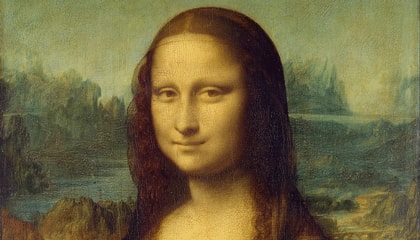
 Photo Credit: Wikimedia Commons
The Mona Lisa and The Last Supper have one thing in common: besides being among the most infamous works in the world, they were created by the great Leondard da Vinci. The Mona Lisa is widely regarded as one of humanity’s greatest treasures, with up to 10 million people visiting the painting in the Louvre every year.
Leonardo da Vinci was, of course, a painter, but he was also an engineer, architect, inventor, and student—a true Renaissance man. His father noted his artistic talent at a young age, and after acquiring basic reading, writing, and math skills, he was apprenticed to the sculptor and painter Andrea del Verrocchio of Florence at 15. Under his guidance, da Vinci developed his painting and sculpting skills, and when he was around 30, he began his first commissioned work, The Adoration of the Magi, though he never finished it.
Only a few of da Vinci’s paintings and sculptures have survived today, which is exacerbated by the fact that he produced so few works. Nevertheless, the work he did complete is among the world’s most revered, the first being The Last Supper. Painted during his time in Milan, working for the ruling Sforza clan, from 1495 to 1498, it is a mural in tempera and oil on plaster.
Created for the refectory of the city’s Monastery of Santa Maria delle Grazie, the painting is 15 by 29 feet and features the Passover, with Jesus Christ addressing his apostles. The composition is remarkable, and easily the most celebrated depiction of the iconic moment when Jesus tells his disciples that one of them will betray him. What is visible is the ensuing chaos, with the apostles recoiling at the declaration and looking at one another for answers.
In 1499, Milan was invaded by France, and da Vinci escaped to Florence. Here he began a series of portraits—among them, Mona Lisa. Easily one of the most recognizable faces today, the subject’s half-smile has been debated across history. Often thought to depict a courtesan, Mona Lisa Gheradini, historians instead point to Lisa del Giocondo, the wife of Florentine merchant Francisco del Giocondo.
Beyond its mystery and enigmatic style, the portrait uses groundbreaking Renaissance techniques, such as sfumato, the process of employing hazy, soft edges that eliminated harsh lines. In addition, a Louvre employee at the time, Vincenzo Peruggia, stole the painting, intending to return the masterpiece to Italy, which catapulted the Mona Lisa to stardom overnight.
Da Vinci’s genius, which extended far beyond fine art if you can believe it, is best summarized by Sigmund Freud: he was “like a man who awoke too early in the darkness, while the others were all still asleep.”
Sandro Botticelli
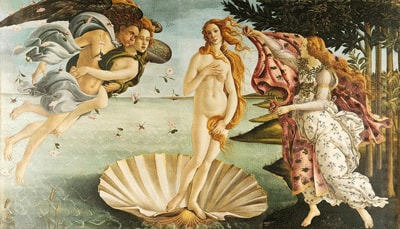 Photo Credit: Wikimedia Commons
One of the most important painters of the Florentine Renaissance, Sandro Botticelli, created The Birth of Venus and La Primavera—two paintings that are repeatedly cited as representing the spirit of the movement. In his youth, Botticelli was apprenticed to the notable painter Filippo Lippi, who created the Madonna and Child. From him, he learned the techniques of panel painting and fresco, as well as a softer, gentler style.
Later in life, he studied Antonio Pollaiuolo and Andre del Verrochi, who showed him how to produce robust, strong figures that he’d carry with him. Botticelli is known for painting in all genres, from devotional and mythological paintings to portraits. His altarpieces, conducted in fresco and on panel, can be found in the Sistine Chapel, while his portraits of secular historical subjects, the first of their kind, have been lost over time.
The most notable of the preserved eight paintings was of Cosimo de’ Medici holding a medal. His skill in portraiture, in particular, gained him the patronage of other members of the Medici family, including Lorenzo de’ Medici and his brother Giuliano, who offered him significant patronage across his career. It was Lorenzo, or perhaps a cousin of his, as some sources argue, that commissioned him to paint The Birth of Venus.
During this time, many of Botticelli’s commissions were linked to marriage customs, in which a chamber would be prepared for the newly married couple, and paintings would be placed within it. These paintings were depictions of love or imitations of famed heroines. Among the greatest of these works were four of Botticelli’s most iconic works: La Primavera, Pallas and the Centaur, Venus and Mars, and The Birth of Venus, each illustrating different aspects of love.
Unlike da Vinci, Botticelli’s works were made for private spaces in Florentine palaces, and were thus viewed only by a few influential people. It took over 300 years for his paintings to be rediscovered and to be accorded acclaim.
Michelangelo
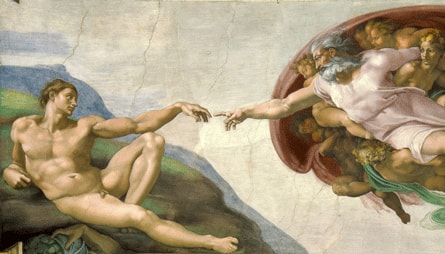 Photo Credit: Wikimedia Commons
Michelangelo, with his mastery of painting, specifically on panel and in fresco, as well as in sculpture, architecture, and writing, was quickly recognized as a genius among his contemporaries. First, he trained as a painter under Domenico Ghirlandai, before working as a sculptor with the support of Lorenzo de’ Medici, who sponsored two other painters on this list: Leonardo da Vinci and Sandro Botticelli.
According to the Smithsonian, although da Vinci and Michelangelo grew up in the same city and were contemporaries, they strongly disliked one another. That said, despite their differences—the former was an observer, while the latter was an idealist—it’s evident that their rivalry at least partly spurred some of the world’s most influential art.
Once Michelangelo made Lorenzo de’ Medici’s acquaintance, he was invited to stay with the patron at his home in Florence, where he was surrounded by the city’s most premier talent. First and foremost, Michelangelo considered himself a sculptor, as evidenced by his works, the Pietà and David, but his magnum opus is widely regarded as his frescoes on the ceiling of the Sistine Chapel.
In 1508, Pope Julius II called the artist to Rome to paint the 12 apostles on the ceiling of the Sistine Chapel—easily the most sacred part of the Vatican, where new popes are selected. As the project progressed over the next four years, Michelangelo ended up painting 12 figures, seven of which were prophets and five sibyls, around the outside of the ceiling, while the center depicts scenes from Genesis. The most famous painting is The Creation of Adam, where God and Adam reach out their hands to one another.
Overall, the fresco contains over three hundred figures, covering roughly five hundred square meters of ceiling. Drawing on supreme knowledge of the human form, particularly in sculpture, he showed his ability to represent the real in vivid detail.
Although many assert he painted the frescoes while lying on his back, his assistants built up wooden scaffolds that allowed him to stand upright through the process. All in all, Michelangelo described the process as “torture” across his poetry, and reaffirmed that he was a sculptor, “not a painter.” Nevertheless, the frescoes have stood the test of time, both in presentation and public opinion.
Raphael
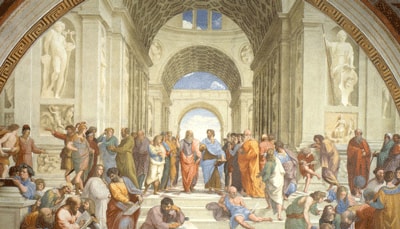 Photo Credit: Wikimedia Commons
Along with Leonardo da Vinci and Michelangelo, Raphael dominated the High Renaissance, a period between 1490 and 1527, widely regarded as the peak of artistic expression in Italy (Sandro Botticelli was a leading painter of the Early Renaissance). A master painter and architect, Raphael is best known for his Madonnas, as well as his frescoes in the Vatican—commissioned by Pope Julius II at the same time as Michelangelo was working in the Sistine Chapel.
Sources claim that Michelangelo also had a rivalry with Raphael, fueled by competing for the same patrons and differing personalities. In the quartet of suites known as the Raphael Rooms in the Vatican, is his most famous fresco—the bold and colorful School of Athens, depicting the most influential scientists, mathematicians, and philosophers.
On the front steps, near the center of the painting, is the pre-Socratic philosopher Heraclitus, represented as solitary and brooding. Added late to the fresco, he is known as “the obscure” and “the weeping philosopher.” What’s more, scholars believe that this representation of the most miserable man in Ancient Greek philosophy is supposed to be Michaelango, and even looks like him!
Born in Urbino, Italy, in 1483, during a time in which the city was a cultural hub, Raphael learned basic painting techniques from his father, Giovanni Santi, who was a painter for the Duke of Urbino. When his father passed away in 1494, Raphael, at just 11 years old, took over his father’s workshop and quickly made a name for himself. Soon after, he was invited to apprentice under acclaimed painter Pietro Vannuccini, known as Perugino.
During this time, Raphael developed his painting style before moving to Florence and began work on a series of gentle, intimate portraits of the Madonna. Although he would continue to paint the Virgin Mary upon his relocation to Rome, under the sponsorship of Pope Julius II, these works were incredibly serene and expressive, considered to be bolder than his later work.
Later, his style in Rome would come to emphasize movement and splendor, as evidenced by the iconic Sistine Madonna, commissioned again by Pope Julius II. During the first two decades of the 16th century, he devoted his time to creating portraits before eventually becoming a key architect for St. Peter’s Basilica upon the appointment of Pope Leo X.


