For many, the Christmas tree has become a cherished holiday tradition. Whether you prefer the smell of fresh pine or the convenience of an artificial tree, coming together with loved ones to decorate it provides a warm sense of communion we look forward to all year.
But what you may not realize is that you’re taking part in a long-standing custom with roots that stretch back to ancient Egypt and Rome. From the reverence of evergreens among Pagan Europeans to the popcorn strings and paper garlands popularized during Queen Victoria’s reign, the Christmas tree carries a rich and varied history.
The Origin of the Christmas Tree
Even before the rise of Christianity, plants that remained green year-round held special significance during the winter months. Believed to ward off evil spirits, evergreen boughs were often hung over doors and windows.
In ancient Egypt, people worshipped the sun god Ra, who was depicted with the head of a hawk and a solar disk crown. They believed that during winter, Ra grew weak, but at the solstice—the shortest day and longest night of the year—he began to recover. To commemorate this turning point, Egyptians filled their homes with green palm fronds and papyrus reeds, symbols of Ra’s triumph over death.
Meanwhile, in early Rome, the winter solstice was celebrated with a grand festival called Saturnalia, held in honor of Saturn, the god of agriculture. Romans knew their farms and orchards would be green again soon, and they marked the occasion not only with feasting but also by decorating their homes and temples with evergreen boughs.
The Modern Christmas Tree
The modern Christmas tree is widely regarded to have originated in western Germany. Sources record people decorating trees within their homes or even building pyramids of wood with evergreens.
The “paradise tree,” a fir adorned with apples and representing the Garden of Eden, was the main prop in a popular medieval play about Adam and Eve. The custom evolved to Germans setting up paradise trees in their homes on December 24th, the feast day of Adam and Eve.
Soon, they began hanging wafers on it—representing the eucharistic host, the Christian sign of redemption—which was later replaced by varying cookies. By the 16th century, the paradise tree and the wood pyramid combined to form the Christmas tree as we know it.
By the 18th century, the tradition had become popular among German Lutherans, and by the following century, it was firmly rooted in German culture. From there, the custom was adopted in England during the early 19th century.
In 1846, Queen Victoria and her German prince, Albert, were depicted in the Illustrated London News with their Christmas tree, making the tradition fashionable among their adoring subjects. The Victorian tree was adorned with toys and small gifts, candles, popcorn strings, ribbons, paper garlands, and more.
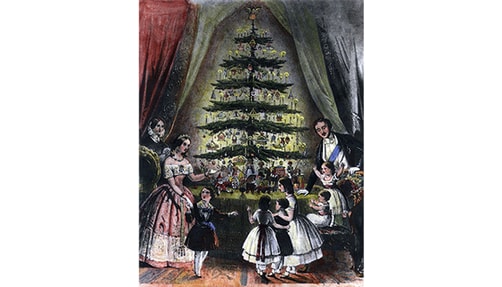

An engraving published in the 1840s of Queen Victoria and Prince Albert.
Photo Credit: Wikimedia CommonsHow the Christmas Tree Came to America
Americans were slow to embrace the Christmas tree. Although the first records of cutting down trees for use date back to the 1820s in Pennsylvania’s German community, many viewed the custom as a pagan symbol and therefore rejected it.
In New England, the first Puritan leaders decided that Christmas celebrations were unholy, and in 1659, the General Court of Massachusetts enacted a law making the observance of December 25th a penal offense. But when the aforementioned royals embraced the Christmas tree, so did East Coast American society, and this time, the tradition took root. Particularly when Godey’s Lady’s Book, the leading women’s magazine in America, reprinted the illustration of Queen Victoria and Prince Albert with their Christmas tree a couple of years later.
By the 1890s, most countries had begun decorating their trees with ornaments. However, a difference is noted in tree sizes: Europeans preferred smaller trees, around four feet tall, while Americans preferred taller trees that extended from floor to ceiling. And when electricity came into being, people could keep their trees lit for days on end, whether in town squares or in the comfort of their homes.
The Artificial Christmas Tree
In the 1880s, Germans began making goose-feather trees for Christmas. Later, in the 1930s, Americans would take this practice further by making trees from brush bristles. Today, many have embraced aluminum and plastic trees, which took root in the 1950s and 1960s.
According to a recent Nielsen survey, the popularity of the Christmas tree industry continues to grow, with 83% of American households opting for an artificial tree. And as climate change worsens, it has become more difficult for trees to grow, though there are pros and cons to both types of trees.
What is for sure is that the Christmas tree is the most-enduring element of the festivities—and it's here to stay.
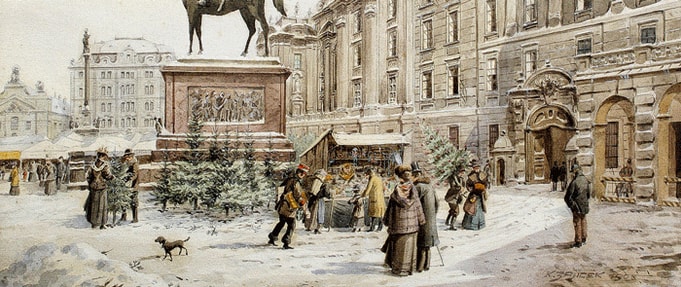
Featured image: Carl Wenzel Zajicek / Wikimedia Commons


