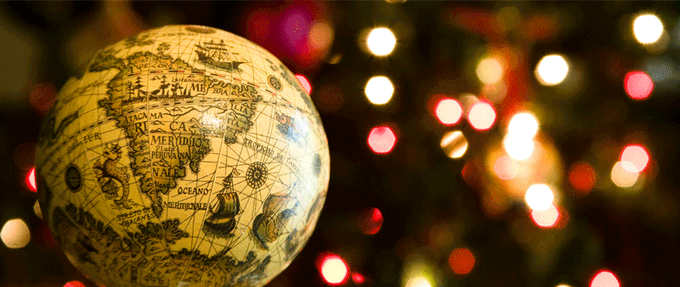
Christmas is a worldwide holiday, yet it is celebrated differently from place to place—sometimes even on different days. In the United States, we’ve embraced traditions like Santa Claus, the tree, and gift exchanges, but there are so many other wonderful customs around the globe to learn about and appreciate.
At its essence, Christmas, wherever it is celebrated, is a time to be with loved ones and bask in the warm feelings of generosity and kindness. Whether you embrace the religious context at the holiday’s core or have adopted your own traditions, there is no doubt that people of various backgrounds and experiences become united under the shared joy of the season.
Fueled by the spirit of togetherness found in Christmas, take a moment to learn about how cultures around the world put their own unique spin on the holiday. From a KFC feast in Japan to the burning of the devil in Guatemala, here are the fascinating origins behind twenty countries’ most beloved customs.
Australia
Given that the holiday takes place during the summer, those in the land down under don’t have a “white Christmas.” Instead, many head to local beaches, basking in the warm weather by enjoying barbecues and cricket. In recent years, however, according to the BBC, many have embraced Christmas in July, when Australia is in the depths of winter.
Austria
Children in Austria are in for a much worse fate than coal if they’ve been naughty this year. Although in the United States, holiday fiend Krampus—depicted as half-goat, half-man, and anti-Santa—is a figment of pop culture, in Austria, Krampus is a legend that has been haunting the young for hundreds of years. Born of Pagan origins and from the country’s Alpine region, the demonic creature has become a Christmas icon alongside the more welcoming St. Nicholas.
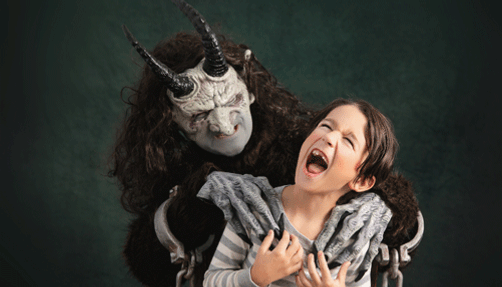

Krampus scaring a young child.
Photo Credit: Melissa Jenkins / CanvaBrazil
In Brazil, many families gather for a late dinner on Christmas Eve before heading to a Midnight Mass service or Missa de Galo (mass of the Rooster), which finishes around 1am. After the service, there are often large fireworks displays, and in cities or larger towns, electric lights will be configured in the shape of a Christmas Tree.
Catalonia
In the Catalonian region of Spain, many display a nativity scene in their homes—the representation of the birth of Christ—but with one key addition: a person wearing a red barretina hat, called el caganer, or “the pooper.” According to Time, the caganer has existed since the Baroque period, in the late 17th to early 18th centuries, but many are unclear why this tradition was created. Nevertheless, poop also pops up in another tradition, called the Caga Tió, or Tió de Nadal, which is essentially a log that is fed scraps of food during the Holidays, and then, on Christmas, is battered with a stick and sung to by children for presents.
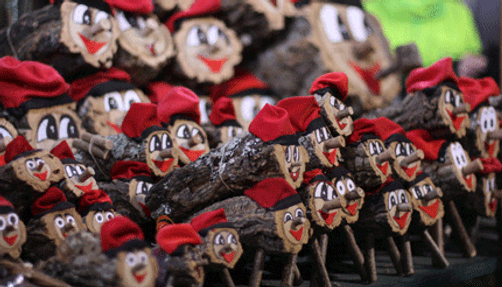
Catalan tradition, caga tió.
Photo Credit: CanvaChina
Only a small percentage of the population in China is Christian, so much of the festivities are limited to major cities, where they decorate with Christmas trees, lights, and more. In China, Santa is called 'Shengdan Laoren,' which means 'Old Christmas Man.' According to the Confucius Institute of Scotland, a tradition becoming popular is the giving of apples on Christmas Eve as a symbol of peace and friendship.
Denmark
In mid-December, when Christmas is celebrated, Denmark is at the depths of winter, with sunlight lasting only about seven hours a day. As such, the holiday is celebrated with many colorful lights, strung around homes and shopping centers alike. Danish Christmas is celebrated on Christmas Eve with a large feast, followed by the whole family joining hands and literally singing and dancing around the tree.
Estonia
Estonia during Christmas feeds all our winter wonderland dreams, with sprawling markets and villages. The capital, Tallinn, is considered by many to be the birthplace of the public Christmas tree tradition, dating back to 1411, when a fir tree was put up by the guild of the Brotherhood of Black Heads.
France
In France, Yule logs made of cherry wood are often burnt in homes. Tradition holds that the log was brought inside on Christmas Eve and covered with red wine before burning. Although not during Christmas, many also prepare and share a galette des rois on January 6th for Epiphany, when the Three Wise Men arrived in Bethlehem. In the French cake, a small charm is hidden inside, and whoever finds it is crowned king or queen for the day.
Greece
It wasn’t until the 19th century that decorating Christmas trees was adopted in Greece. Before that, and even today, the traditional holiday symbol is a boat called karavakia (meaning “little ship” or “small boat”), which, according to the Mariners’ Museum and Park, is decorated to celebrate the country's relationship with the sea. Often, sailors would be gone for long periods of time, whether fishing or trading, and those at home would welcome them back with small wooden boats.
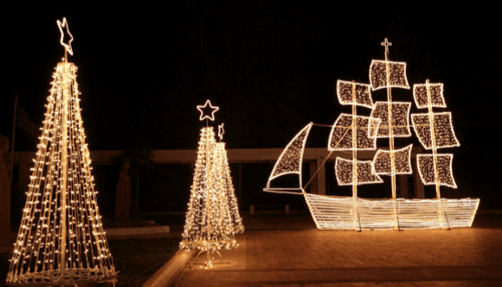
Greek holiday tradition of karavakia, meaning "little ship."
Photo Credit: CanvaGuatemala
The Christmas season in Guatemala is very special and busy—with the Quema del Diablo (burning of the devil) on December 7th, then the Posadas Navideñas (Christmas posadas), and then the Día de los Reyes Magos (Three Kings Day) in January. But the festivities open at exactly 6pm each year with the traditional burning of the devil and bonfires built outside homes to cleanse away any evil.
Haiti
Many Christmas traditions in Haiti take place on December 24th, when families attend midnight Mass and carolers sing hymns through the neighborhoods. After Mass, everyone returns home for Revellion, a special meal that in French means “to wake up.” Indeed, this meal often lasts until dawn, with a spread of rice and beans, tassot cabrit (fried goat meat), accra, pineapple upside-down cake, and much more. During this time, children will also set out their shoes filled with straw, which Tonton Nwèl (Santa Claus) will replace with presents.
Iceland
Although Iceland may not have a Santa Claus, they do have 13 Yule Lads, called Jolasveinar. According to folklore, they live in the highlands with their troll parents, Grýla and Leppalúði, and their black cat, Jólakötturinn (the Christmas Cat). Their mother will cook and eat naughty children in a pot, while Jólakötturinn eats anyone who doesn’t receive a new item of clothing, and finally, the Yule lads are said to be pranksters, who leave children small presents (or, if you’re naughty, rotten potatoes), left in shoes on windowsills.
Ireland
For many in Ireland, December 8th is the unofficial start of Christmas celebrations. According to the Government of Ireland, it used to be a school holiday when families from across the country would flock to the capital to complete holiday shopping. On Christmas day, starting at sunrise, people take to the sea for cold plunges in coastal spots like Forty Foot in Dublin and Bundoran Beach in Donegal.
Italy
One of the most significant and popular ways Christmas is celebrated in Italy is through the Nativity scene. Beginning in 1223 with St. Francis of Assisi, many Italians have since chosen to have the display in their homes. Also, celebrated on January 6th is the Feast of the Epiphany, where a witch-like figure called La Befana delivers gifts to children. According to Sky News, she is linked to the Three Wise Men parable.
Japan
Only about one percent of the Japanese population is Christian, so Christmas isn’t a national holiday in Japan. Nevertheless, “Christmas Chicken” is widely eaten on that day, with the Smithsonian Magazine claiming it is from the Kurisumasu ni wa kentakkii! (Kentucky for Christmas!) marketing campaign in 1974. The American chain KFC says it got the idea when a foreigner visited Tokyo and said the only turkey equivalent they could find on Christmas was at the establishment. Since then, KFC has become so in demand that it takes orders in advance.
Mexico
Called la Navidad (the nativity), Christmas in Mexico is a long and vibrant celebration that lasts from December 16th to January 6, with a final observance on February 2nd. The posadas (processions), which begin on December 16 and end on December 24, take place over nine nights and reenact the journey of Joseph and Mary to Bethlehem. During the celebrations, two children will carry statues of Mary and Joseph as they travel from house to house, seeking shelter.
Phillipines
Around 4 in 5 Filipinos are Catholic, so not only is the holiday a very big deal, but the Philippines also holds the world’s longest celebration, beginning on September 1st and lasting through the Ber Months until December. On the opening day, Jose Mari Chan, the country’s voice of the season, blares across malls, and decorations such as parols —star-shaped lanterns that symbolize the star of Bethlehem—take over. Instead of Christmas Eve, Noche Buena is celebrated, which constitutes midnight Mass followed by a grand feast.
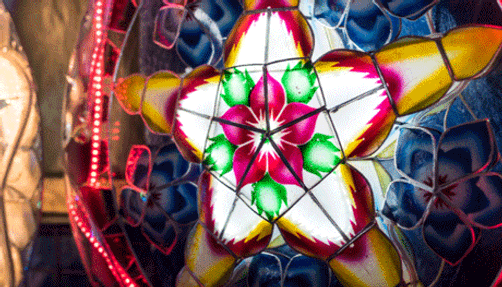
Filipino tradition of parols, which are star-shaped lanterns.
Photo Credit: CanvaSyria
Christians in Syria were able to publicly celebrate their first Christmas since the end of the Assad regime in 2024. At Epiphany, children receive gifts from a camel, which symbolizes the camels that carried the Three Magi to Bethlehem to see baby Jesus. On Christmas Eve, the gates around people’s homes are shut to represent the years of persecution when worship had to be done in private.
Ukraine
On Christmas Eve, families come together for Sviata Vecheria (Holy Dinner), where the table is served with 12 dishes, each representing a different apostle. However, the main dish is Kutia, a mixture of boiled wheat, poppy seeds, and honey. In many homes, you’ll find a didukh, which is a sheaf of wheat stalks, meant to symbolize the spirits of ancestors. As such, dishes are left at the table for the dearly departed.
Zimbabwe
On Christmas Day, most celebrants in Zimbabwe head to a church service, followed by parties throughout the neighborhood, full of good food and gift exchanging. Some people will have a traditional Christmas tree, but many opt to decorate their living rooms with numerous plants.
Feature image: Canva


