What would come to be known as the Boston Tea Party involved a group of roughly 70 colonists, many disguised as Mohawk warriors, who boarded three ships at Griffin’s Wharf and threw 342 chests of tea overboard into the Boston Harbor.
This act of defiance was a response to the Tea Act of 1773, which gave rise to the famous saying “taxation without representation” and further escalated tensions in the colonies toward the American Revolution. One of the first major responses to British rule, the demonstration showed that Americans would no longer tolerate tyranny.
In American Tempest, historian Harlow Giles Unger reveals the truth behind this day, and what would follow. Notably, the propelling of America onto the path towards revolution and the ultimate birth of an independent nation. Although largely a symbolic act against British taxation—at no less a cost than over £10,000 in tea—the ensuing chain of events would transform the colonies into the social, political, and economic superpower the United States is recognized as today.
The New York Times-bestselling author of more than 30 books, including The Last Founding Father: James Monroe and a Nation’s Call to Greatness, which led to a designation from the Washington Post as a "Premier Presidential Biographer," Unger has solidified himself as a leading authority in American history and education.
To shed new light on the Boston Tea Party and examine its lasting consequences, read the first chapter from Harlow Giles Unger’s American Tempest, and then keep reading!
For a preview of American Tempest, read on—then download the book today.
____________________

____________________
American Tempest
Chapter 1: “Rally, Mohawks!”
Thousands had pushed into the Old South Meeting House, “turning the House of God into a den of thieves,” according to Massachusetts Chief Justice Peter Oliver. “Thus assembled, they whiled away the time hissing and clapping, cursing and swearing until it grew near darkness and then the signal was given to act their deeds of darkness.”
A burst of blood-curdling war whoops from without silenced the huge congregation for a moment.
“Rally, Mohawks!” came a cry from the rear—and again the terrifying war whoops from beyond. From the pulpit, moderator Samuel Adams called out, “This meeting can do no more to save the country.” And the doors of the church burst open, spilling congregants onto the stony parvis in the icy moonlit air.
“Boston harbor a tea-pot tonight!” someone shouted.
“Hurrah for Griffin’s Wharf!” answered another.
“The Mohawks are come!” a third voice called.
Fifty or more men stood huddled in the shadows of the buildings opposite the church—blankets draped over their heads and shoulders, their faces smeared with lamp-black. Poised as Indians, they wore tomahawks, knives, or pistols in their belts and carried an axe or hatchet in their hands. Together, they represented the first—the original—Tea Party Patriots and would redound through history as a collective symbol against government taxation without the consent of the taxed.
As the throng burst from the church, the Mohawks signaled to them to follow in silence along Milk Street, then a sharp right toward the waterfront, flowing like molten lava—steadily, relentlessly—until it reached Fort Hill. Other “Indians” stepped into the line of march, “one after another, as if by accident, so as not to excite suspicion.”
Three ships lay tied to the pier as the procession approached Griffin’s Wharf. Armed guards protected the entrance, but stood away as the Indians approached. The crowd of followers halted on a rise above the wharf to watch the Indians as they boarded the ships. Like a swarm of locusts, the Indians spread across the decks, with some attaching blocks and tackles to lift chests from the holds. Chest after chest rose from the darkness of the ship’s bowels onto the decks, where axes and hatchets split their seams so expertly that spectators barely heard a sound. “We resembled devils from the bottomless pit rather than men,” recalled Joshua Wyeth, a sixteen-year-old blacksmith at the Tea Party. “Many of [us] were apprentices and journeymen, not a few, as was the case with myself, living with Tory masters.
“We boarded the ship . . . and our leader in a very stern and resolute manner, ordered the captain and crew to open the hatchways and hand us the hoisting tackle and ropes, assuring them that no harm was intended them. . . . Some of our number jumped into the hold and passed the chests to the tackle. As they were hauled on deck, others knocked them open with axes, and others raised them to the railing and discharged their contents overboard. . . . We were merry . . . at the idea of making so large a cup of tea for the fishes.”
A reporter from the Massachusetts Gazette was also on the scene:
“They applied themselves so dexterously to the destruction of this commodity that, in the space of three hours, they broke up three hundred and forty-two chests, which was the whole number in these vessels, and discharged their contents. . . . When the tide rose, it floated the broken chests and the tea insomuch that the surface of the water was filled there-with a considerable way from the south part of the town to Dorchester Neck and lodged on the shores. . . . The town was very quiet during the whole evening and the night following. Those who were from the country went home with a merry heart, and the next day joy appeared in almost every countenance, some on account of the destruction of the tea, others on account of the quietness with which it was effected.”
The Tea Party left government officials irate, with Chief Justice Peter Oliver condemning it as a “villainous act.” Tea Party leaders, he said, had “assembled the rabble . . . to perpetrate the most atrocious acts of treason and rebellion.”
One of the brilliant minds of his native Boston, Justice Oliver pointed out that few, if any, of the men who dumped the tea into Boston harbor that night could even explain their irrational behavior. None consumed as much tea as he did ale, rum, or whiskey; few had any objections to others consuming tea, including their wives; and most bore no malice toward the East India Company, which owned the tea. Moderators at the church who inspired the assault on the tea ships at Griffin’s Wharf had railed against taxation, yet the tax on tea was negligible—a mere three-pence per pound, or slightly more than one-tenth of one penny for a nine-pence cup of a beverage consumed largely by women as “a sign of politeness and hospitality . . . a mark of civility and welcome.” On the surface, the Tea Party seemed a senseless, wanton act of vandalism—beyond the ludicrous, drawing the disbelief of most Americans, the ill will of many others, and the wrath of government.
“Had they been prudent enough to have poured it into fresh water instead of salt water,” Oliver sneered, “they and their wives and their children and their little ones might have regaled upon it at free cost for a twelve month. But now the fish had the whole regale to themselves. Whether it suited the constitution of a fish is not said, but it is said that some of the inhabitants of Boston would not eat of fish caught in the harbor, because they had drank of the East India Company tea.”
To Samuel Adams and other organizers of the Tea Party, however, the tea had become a symbol of property, and the tax on it represented nothing less than confiscation of that property from its rightful owners or purchasers. In fact, the Tea Tax, small as it was, marked the fourth time in forty years that Parliament had tried to tax Americans without their consent. They began with the Molasses Act of 1733, then added the Grenville acts in 1764, the Stamp Act of 1765, and, finally, the Townshend Acts of 1767, which included the notorious Tea Tax that would irritate Americans for more than eight years and provoke the Boston Massacre in 1770, the Boston Tea Party in 1773, and the American Revolution in 1775.
“I truly can have no property which another can by right take from me when he pleases,” Samuel Adams thundered. “If our trade may be taxed, why not out lands? Why not the produce of our lands and everything we possess or make use of?”
Chief Justice Oliver, however, dismissed Adams’s complaints, insisting that personal ambitions lay behind the carping of Adams and other organizers of the tax protests.
“Toward the latter end of the year 1760,” Oliver explained, “the chief justice of the province of Massachusetts died, and a mentally unbalanced, but politically ambitious young lawyer, James Otis, Jr., swore that if his father was not appointed justice of the superior court [to replace the deceased jurist], he would do all the mischief he could to the government [and] would set the province in a flame if he died in the attempt.” Oliver’s brother-in-law Thomas Hutchinson, a phenomenally prosperous Boston merchant who later became Massachusetts royal governor, agreed that Otis provided the “spark” that kindled the conflagration that eventually engulfed Boston.
At the time of Otis’s outburst, Hutchinson was lieutenant governor of Massachusetts, and the death of the chief justice had interrupted a critical trial with constitutional ramifications. By seniority and years of service in the Massachusetts House of Representatives, Otis’s father, Colonel James Otis, Sr., deserved the higher post. Indeed, two former royal governors had promised him the job as a reward for service as militia commander in the war against the French and for twenty-five years of service as judge in Barnstable, Massachusetts. Elected Speaker of the House of Representatives, Otis was both the logical and the most popular choice, but the new royal governor, Sir Francis Bernard, rejected him because of what he said was a clear conflict of interest: His son, James Otis, Jr., was one of the lawyers representing a group of Salem merchants opposing the crown. Instead, Bernard appointed Hutchinson rather than the elder Otis, and according to Oliver, “the two Otises now exerted themselves, totis viribus [with all one’s might], to revenge their disappointment in Mr. Hutchinson’s destruction.”
Bernard’s choice of Hutchinson set off a storm of protests. Although a brilliant graduate of Harvard College, Hutchinson was one of Boston’s leading merchants and faced no less a conflict of interest in judging a group of Salem merchants than the elder Otis. In addition, Hutchinson was not even a lawyer and had no legal training. Even Hutchinson himself puzzled over Bernard’s decision to appoint him, given Bernard’s own background in the law. Hutchinson’s deficiencies became evident when he took his seat on the bench and faced the brilliant arguments of the younger Otis—a consummate lawyer who attacked with a vengeance. He did not disguise his intent to humiliate the great merchant, who, Otis believed, was more responsible than Bernard for crippling his father’s career and, indeed, damaging the older man emotionally.
“Otis was a flame of fire,” according to John Adams. “He demonstrated the illegality, the unconstitutionality, the iniquity and inhumanity” of the crown’s case so cogently “that every man appeared to me to go away ready to take arms against it. No harangue of Demosthenes or Cicero ever had such effects.” Adams was a young lawyer then and had come to observe what he and many of his colleagues considered one of the most important cases in colonial history. “American independence,” Adams enthused, “was then and there born; the seeds of patriots and heroes were then and there sown.
At the heart of the case was whether a customs official had the right to issue a blanket search warrant, or “writ of assistance,” and, without warning, “search in all suspected places” for smuggled goods—on a merchant’s ship, in his barns, in any and every room of his home and anywhere on the merchant’s property he chose. Otis called writs “against the fundamental principles of law,” arguing that “every man is an independent sovereign. . . . His right to his life, his liberty, no created being could rightfully contest. Nor is his right to property less contestable.”
The crown, however, did not dispute man’s right to property—only his right to property that he smuggled to America without paying import duties.
The roots of the dispute stretched back three decades to 1733, when Britain passed the Molasses Act—the first of a series of ill-advised tax laws that would eventually incite Americans to rebellion. The Molasses Act of 1733 added a six-pence-a-gallon duty on foreign molasses, which American distillers claimed would all but destroy their industry, drive many of them into bankruptcy, and put thousands of their employees out of work. It was not the first time Parliament had interfered in American trade, but it was the first time Parliament had enacted a tax that seemed to limit the growth of a colonial industry. The Navigation Act of 1660, for example, had restricted the carrying trade in and out of the American colonies to British or American ships, but the restriction spurred the growth of an enormous American ship-building industry that not only eclipsed England’s shipbuilders but made it the finest such industry in the world. New England’s huge, virgin forests yielded seemingly endless supplies of the finest oak for ships’ hulls and incomparably strong and flexible white pines for use as masts. Massachusetts shipbuilders built better quality ships at half the price of comparable English ships, and because of the nearness of forests to the sea, they built them in one-third the time. By 1700 Massachusetts shipyards alone were launching 140 ships a year, and by mid-century, American shipyards as a group had built more than 30 percent of all the ships sailing under the British flag.
And because Boston lay in a protected harbor closer to Britain than any other large American seaport, it rapidly became America’s richest, most important shipping center. It boasted other advantages as well. For one thing, it lay on the edge of the infinitely rich New England fishing and whaling grounds. For another, its unusual contour allowed far more wharves to be constructed than in a conventional port city lying in a straight line along the water’s edge. Eighteenth-century Boston was almost an island—its only tie to the mainland a narrow little strip of land called Boston Neck, which reached across an expanse of tidal marshes and mud flats that would eventually be filled and renamed Back Bay. Seen from above, the town lay in the water like a fallen bird, its stubby wings outspread, one of them stretching into the Charles River on the northwest and the other reaching into the harbor pointing the way to the open sea. Its head—the North End—lay in the middle of the water, beneath Charles-town. Its multiform shape gave it an enormously long shoreline that permitted construction of endless numbers of wharves and attracted more merchants than conventional ports, along with thousands of waterfront workers from Europe, England, Scotland, Ireland, and elsewhere.
At high tide the Charles River estuary flooded the mud flats and salt marshes to the west of the city and formed the Back Bay. On the east, or harbor side, endless finger piers reached into the water, side by side, embracing hundreds of sailing ships that glided in and out of the harbor each day. After viewing the many ships, the shops, and the opulent mansions of Boston’s merchants, Swedish botanist Peter Kalm, who came to America in 1748 on a natural history survey, remarked, “They outdo London.” Later, he lauded the city’s “grandeur and perfection. . . . Its fine appearance, good regulations, trade, riches, and power are by no means inferior to those of any, even the most ancient towns of Europe.”
Unlike Britain, where class barriers frustrated the ambitions of those seeking wealth, the colonies offered unimagined wealth to almost any talented, imaginative, hard-working man, regardless of social or economic class—provided, of course, he fit into community racial and religious norms. Many of Boston’s wealthiest merchants began in small, specialized shops—books, in the case of Thomas Hancock. Books were a good choice in a colony that, from its beginnings, made education and the teaching of literacy compulsory and created a population that depended on reading as a major leisure activity. Besides the Scriptures, every bookseller carried tracts and sermons of every minister of note—sold in clumsy, uncut, unbound sheets. Recognizing the need for bookbinding facilities in Boston’s growing printing and publishing industry, Thomas Hancock learned bookbinding, became a master bookbinder, and solicited bookbinding orders from Boston’s printers and booksellers, who were elated to turn the jumble of unprinted sheets into rows of neatly shelved, easy-to-find, bound books. Hancock accepted payment in stocks of stationery and printed materials as well as cash. By the end of six months, he had accumulated enough to expand his shop to include stationery—writing paper, quills, sealing wax, inkhorns—even spectacles—along with an enormous array of books: “Bibles large and small, Testaments, Psalters, Psalm Books with tunes or without, Singing-books, School-books . . . Books on Divinity, Philosophy, History, Navigation, Physics, Mathematics, Poetry. . . .”
Only one constraint slowed Boston merchants’ breathtaking race to riches: a shortage of cash. Most New Englanders did business by barter, with some trading their labor or handiwork for food, lodging, and other necessities. Others hunted, fished and farmed to survive. Merchants routinely accepted produce, livestock, pelts, whiskey, and other goods as currency. Although many small merchants fell by the economic wayside, bolder—and luckier—merchants gambled every penny they had on growth, expanding into general stores with a wide variety of cloth (calico, chintz, muslin, cotton, buckram, taffetas, damasks, and silks), thread, fans, girdles, “and sundry other sorts of Haberdashery,” according to an advertisement in the Boston News-Letter. The ad also listed “Silk Shoes, Men’s and Women’s Hose, millinery, compasses, hour glasses, leather, cutlery, and such staples as sugar, tea and corn.” The most successful merchants organized their stores into departments; some offered volume discounts, and all tried stocking their shelves according to seasonal needs, selling off one season’s goods before the new season began, to avoid accumulating shopworn inventories. Their advertisements were clever for that era:
Excellent Bohea Tea, imported in the last ship from London:
sold by Tho. Hancock.
N.B. If it don’t suit the ladies’ taste, they may return the tea and receive their money again.
The women’s dress department was usually the largest, with cloth, ribbons, knee and shoe buckles, hats, fans, and other items. Hardware departments, with brass compasses, fire steels, larding pins, swords, and so forth, provided about 10 percent of total sales. Rum and similar provisions also contributed about 10 percent of sales, whereas coal and ships’ stores accounted for just over 1 percent in the early eighteenth century and tea somewhat less than 1 percent. Americans had yet to discover the pleasures and pomp of tea and tea parties.
Few shoppers could not find what they needed at the House of Hancock, the House of Hutchinson, or the other great merchant houses. Flocks of city and country folk filled Boston’s general stores store each day, and as sales increased, some merchants bought larger quantities at lower costs and expanded into wholesaling, supplying shopkeepers, farms, and merchants in smaller towns. The largest houses—like the House of Hutchinson and House of Hancock—also supplied the government and the military, which forced them to extend credit and drew them into banking.
The leap into merchant banking propelled them into still-larger enterprises such as “commodity barter”—the exchange of shiploads of commodities with merchants in other colonies and overseas without exchanging cash—or paying any taxes. In effect, each colony was an independent nation, and none trusted the value of the other’s paper money. Merchants in different colonies paid each other with either specie—gold or silver coins—or “commodity money.” In one transaction, a Rhode Island arms merchant wrote to Thomas Hancock that he was “bound to Boston in order to buy two hundred small arms for our force and two hundred blankets for them, and as our currency will not pass at Boston, I prepare to pay for the above articles in molasses.”
When the values of commodities in both ends of a trade were unequal, one merchant simply gave the other “change” in the form of nonperishable staples, such as gunpowder, molasses, corn, rum, or, more commonly, salted fish.
Each expansion opened other opportunities. Commodity trading, for example, grew into two-way international trade and even more profitable triangular trade, which involved huge, complex three-way trades between three continents—again, all tax-free. Reinvested profits on the first trade added to the profits on the second, and when the accumulated profits were reinvested carefully in a third trade, all the seamen, ships’ officers, and, of course, the merchant often garnered undreamed-of riches when their ship unloaded its last cargo at the end of its last leg . . . as long as the ship didn’t fall prey to a storm or pirates.
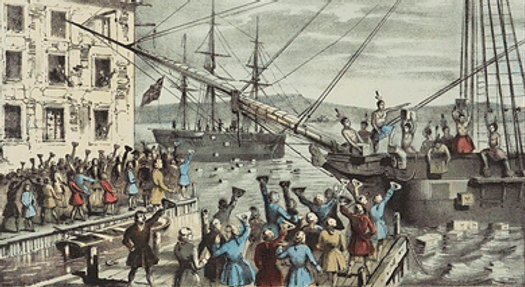

Tea Sabotage in Boston Port by Nathaniel Currier (1846).
Photo Credit: Wikimedia CommonsAll too often, one leg of a triangular trade involved the purchase of slaves in Africa and their shipment to the West Indies or the American South for resale in barter deals for molasses, sugar, rum, or tobacco. In two-way trade, a New England merchant, for example, might sell salted fish to a French West Indies trader for molasses that his ship brought home to New England for distillation into rum. In a triangular trade, he might take his initial cargo to Africa, trade it for slaves, whom he carried to the West Indies and traded for molasses for the New England distillery. To cut costs of international trade, the largest merchant houses bought and operated their own ships.
The most successful merchant-bankers took advantage of every profit opportunity—especially the huge, rough-and-tumble London market for whale oil and whale “bone,” which was actually cartilage. The former was essential for both illumination and lubrication, and manufacturers used whale bone to make corset stays, cap stiffeners, buggy whips, and similar items. The first boats to arrive in England from America with spring supplies each year made the most money, and the most successful merchants always found ways to be first. Although some merchants waited for whalers to bring their catch to Boston for processing and subsequent transport to London, Thomas Hancock sent his ships to isolated whaling settlements along the shores of northern New England and Newfoundland nearer the hunting grounds and closer to England. There, his agents traded badly needed items such as clothing, tools, foodstuffs, and rum for processed oil and bone, which they then carried directly to London before other whalers had even off-loaded their catch in Boston. Once in London, the sailors, who earned a percentage of the proceeds for each load, jumped onto the piers and drove bidding for their cargoes to fever pitch by spreading rumors that theirs might be the last oil cargo to reach port for months. London agents earned 3 percent of the proceeds whereas captains and crews earned 89 percent—either to pocket or to buy goods to bring back to Boston to resell for even more money.
As they prospered from whale oil transactions, some Boston merchants bought or built their own fleets. By 1732 the House of Hancock owned more than a dozen ships. Whenever overproduction of a commodity sent prices too low to be profitable, Hancock simply dropped out of that particular trade and looked elsewhere for profit opportunities. One year he bought twenty thousand acres of timberland in Connecticut, Massachusetts, and Maine to convert into lumber. In Boston he bought some rental properties and a three-eighths share in Clarke’s Wharf, the city’s longest and busiest finger pier after Long Wharf. Renamed Hancock Wharf, it stretched into the harbor from Fish Street, where Paul Revere sold silverware, copper engravings, carved picture frames, music sheets, surgical instruments, dental plates, and his own crude drawings.
With wealth came power, of course, and, in 1740, a year after building and moving into his palatial home on Beacon Hill overlooking Boston, Hancock joined the town’s other great merchants—Thomas Hutchinson, Andrew Oliver, Thomas Cushing, Richard Clarke, and brewer Samuel Adams, Sr.—on both the Governor’s Council and as one of five selectmen who ruled the town of Boston as both legislators and executives with control over the city’s finances and commerce. As with elections to the General Court (the provincial legislature), Boston limited voting for selectmen to the town’s six hundred–odd “freeholders”—the wealthiest, most influential white, propertied males who made up about 4 percent of the population.
As leaders in both business and politics, however, selectmen held in their hands the destinies of thousands of farmers, craftsmen, shopkeepers, and small merchants who depended on Boston’s giant merchant-banking houses as a central market to buy supplies and sell goods and services. All had worked together in the friendliest fashion for more than a century—until 1740, when an acute shortage of British currency combined with an economic slump to leave New England farmers, craftsmen, and shopkeepers with too little cash to buy supplies from the big merchant houses. Forced to barter, farmers often found themselves at the mercy of Boston’s merchants, who drove produce prices lower by pitting one farmer against another—and soon threatened the survival of many local farms.
In 1740 Samuel Adams, Sr., the owner of the town’s largest brewery, came up with a scheme to establish a “land bank” to print paper currency of its own and lend it to farmers against the value of their lands, or “real estate.” As producer of New England’s most popular beverage, he had an interest in seeing that farmers who came to town to sell produce could fill their pockets with enough cash to fill their carts with barrels of beer to take home. As Sam Adams’s Land Bank paper gained currency, farmers gained the upper hand in the marketplace, forcing merchants to accept the paper or see suppliers and customers turn to merchants who would. Within a year of its appearance, Land Bank paper began undermining the value of British currency, and Boston’s leading merchant bankers—the Hutchinsons, Olivers, and Clarkes along with Royal Governor Jonathan Belcher, who was also a merchant—appealed to Parliament to outlaw local currency in New England. Farmers descended on Boston to protest, threatening merchants who refused to accept land bank currency.
“They are grown so brassy and hardy as to be now combining in a body to raise a rebellion,” Belcher complained. Believing the mobs of farmers were “ripe for tumult and disorder,” Belcher ordered sheriffs to jail mob leaders and break up demonstrations—with rifle butts if necessary. Although the farmers dispersed, they voted Samuel Adams and other members of the Land Bank party onto the Executive Council. Governor Belcher vetoed their election and Parliament outlawed the Land Bank, converting the Samuel Adams family into bitter foes of British rule in America.
Declared “criminals” and criminally liable for all outstanding Land Bank paper at face value, Adams and his partners became the targets of speculators and charlatans who scoured the farmlands, buying up Land Bank currency at huge discounts, then presenting them to Adams and other Land Bank directors in Boston for payment at face value. The run on Land Bank assets all but bankrupted Adams and created a lasting division between Boston’s merchant-aristocrats and the rest of the economic community—farmers, shopkeepers, small merchant houses, and, most especially, Samuel Adams.
The split—and the bitterness it engendered—reached down into the next generation, when Harvard demoted Samuel Adams’s son, Samuel Adams, Jr., from the fifth-highest rank in his class to the bottom. Harvard’s humiliating system of “gradation” ranked students according to family social and economic standing. Although all acquired the title “Sir” as upperclassmen and alumni, they sat, walked, ate, and slept according to family rank while still in school. The son of a Massachusetts governor or Harvard president stood, marched, or sat at the head of his class in processions, in church, in recitation rooms, and at meals. Next in rank came sons of former governors, trustees, large landowners, major contributors, clergymen, and so on. Sons of farmers ranked last, with Sam Adams, Jr., ranking even lower after the Land Bank fiasco. His father’s plight forced the young man to find work to help pay costs of attending college and sparked what became both a lifelong loathing of Hutchinson and other merchant-aristocrats and a deep hatred for British authority. According to Chief Justice Peter Oliver, Sam Adams was ready to commit any “crime” to overthrow the government. “When asked to draw the picture of the devil,” Oliver recounted, “a celebrated painter responded he would ask Sam Adams to sit for him.”
Want to keep reading? Download American Tempest today.
____________________
____________________
American Tempest
Featured image: The Everett Collection / Canva


