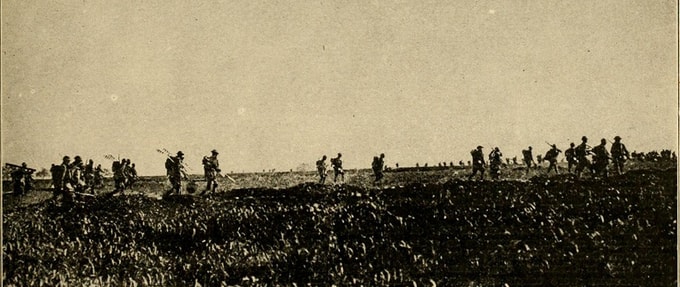
It is popularly believed that the Great War began with the assassination of Archduke Ferdinand in the summer of 1914. However, history is rarely so neat and tidy, and the simmering seeds of the war had already been planted before that fateful bullet found its home. The assassination certainly precipitated events, however, and within a month of the archduke’s death, the Austro-Hungarian Empire had declared war on Serbia, beginning a series of escalations that would plunge the entire continent of Europe into “the war to end all wars.”
As more countries were pulled into the conflict, the Central Powers (Germany, Austria-Hungary, and the Ottoman Empire) believed that they could quickly squelch British and French resistance before turning their attention to Russia. Their expectations proved optimistic, however, and by the end of the year, more than 400 miles of trenches stretched from Switzerland to the North Sea. Along this muddy battlefield, lined with barbed wire and machine guns, soldiers on both sides would remain mired for years to come.
Trench warfare proved to be notoriously bloody and bitter—and largely useless, as neither side gained or lost much for all the bloodshed. The Battle of the Somme last 140 days and resulted in more than a million casualties, yet the front lines moved only a few miles.
“He kept us out of war.”
Despite the grim events that were taking place across the Atlantic, America initially remained neutral in the conflict. In 1916, President Woodrow Wilson won re-election with the help of the slogan, “He kept us out of war.”
The tide of public opinion was beginning to shift, however. Germany had instituted a policy of unrestricted submarine warfare against British vessels in response to a naval blockade imposed upon Germany at the start of the war. This included attacks by German U-boats against merchant and passenger ships, among them the 1915 sinking of the RMS Lusitania, in which 128 Americans lost their lives.
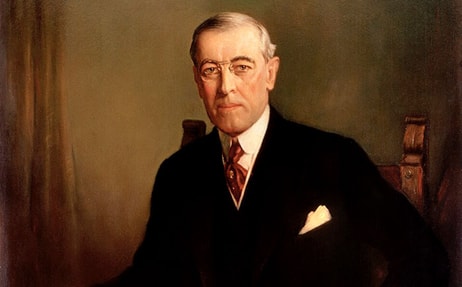

President Woodrow Wilson
Photo Credit: Wikimedia CommonsOn April 2, 1917, President Wilson asked Congress to declare war on Germany. By April 6, America had joined the Great War on the side of the Allied forces. However, it took time for the United States to equip and prepare an army, and more time still to get it to the Western Front. While the first American soldiers landed in France within months of the declaration of war, it would be nearly a year before American troops conducted their first major offensive in Europe.
The Draft
It is somewhat difficult to imagine today, but in 1917, the United States had only a relatively small military. To fight the battles facing the Allies on the Western Front, something much more ambitious would be required.
The earliest American soldiers who arrived in France were part of an American Expeditionary Force led by General John J. Pershing. Back home, President Wilson signed the Selective Service Act into law on May 18, 1917. This act implemented a draft that would quickly swell the American army from around 100,000 soldiers to more than 2 million. By May of 1918, roughly 10,000 American troops were arriving in Europe every day.
Hopeful that they could end the war before the Allies were reinforced by the coming American troops, Germany launched a “Spring Offensive” early that year, met by opposition from entrenched Allied forces and from the earliest American Expeditionary troops. By May 28, the American 1st Infantry Division captured the village of Cantigny from German forces in the first major American military action of the war. By that time, there were already more than 650,000 American soldiers in France.
The Hindenburg Line Broken
As American forces were deployed along the Western Front, they began turning the tide of a stalemate years in the making, in battles that have become part of military lore. By September of 1918, with the help of American troops, the Allies had broken through the heavily fortified Hindenburg Line, which ran from Arras to Laffaux.
This was part of the “Hundred Days Offensive,” a massive push of more than half-a-million American and more than 100,000 French troops, which reclaimed in only a matter of days territory that Germany had held almost since the war began.
Among the massive undertakings spearheaded by American troops was the Meuse-Argonne Offensive, which has been called the largest battle in American history. Lasting 47 days, this massive engagement cost the lives of more than 26,000 American soldiers, and drove the German forces back 40 miles.
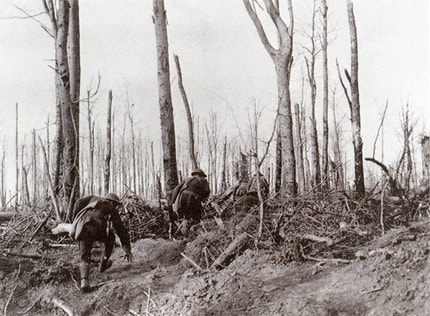
Marines at the Battle of Belleau Woods.
Photo Credit: Wikimedia CommonsThe Hundred Days Offensive marked the beginning of the end of the war. Exhausted from prolonged fighting, and now overwhelmed by millions of fresh American troops, the German government reached out to President Wilson on October 4, 1918, requesting an Armistice. However, the terms with which Wilson met the proposal gave the Germans pause, and war continued for a little over a month, with the forces of the Central Powers ceding ground on all fronts.
The Eleventh Hour
On November 11, 1918, in a railway car at Compiegne, France, German officials signed an Armistice agreement which was to take effect at 11am – the eleventh hour of the eleventh day of the eleventh month. Despite the fact that the armistice was signed at a few minutes after five in the morning, fighting continued for several hours, right up to the 11am deadline, with soldiers eager to “claim they fired the very last shot in the war.”
2,000 soldiers were killed between the signing of the Armistice agreement and the moment when it took effect, with a few skirmishes continued in subsequent days, but for the most part, the war was over. The Paris Peace Conference took place in January of 2019, marking the first European visit by a sitting U.S. president, and by June 28, a German delegation signed the Treaty of Versailles, effectively bringing an end to the war.
Called the “war to end all wars,” there was a hope that the Great War would do just that. The victory of the Allied forces seemed to achieve many ambitions held by President Wilson, including the formulation of a League of Nations, a precursor of the modern United Nations. However, the end of the war also sowed the seeds of World War II, which would follow in just a few short years.
The Treaty of Versailles laid the blame for the war on Germany, assessing harsh reparations for “all the loss and damage to which the Allied and Associated Governments and their nationals have been subjected as a consequence of the war imposed upon them” by the aggression of the Central Powers. Many Germans found these conditions too harsh, and a resentment of the terms of the treaty became the undercurrent which led to the rise in power of Adolph Hitler’s Nazi party and the beginning of World War II.


